


Executive Programme in Product Innovation with AI & Agentic AI
Go from product thinking to AI-first product building
UpcomingInvalid liquid data
What is the Executive Programme in Product Innovation with AI & Agentic AI?
The Executive Programme in Product Innovation with AI & Agentic AI is a 20-week executive programme from IIM Kozhikode designed for professionals who want to innovate, design, build, and scale AI-powered products using Generative AI and Agentic AI. The programme combines AI-first product thinking with hands-on learning across the entire product lifecycle; from opportunity discovery and rapid prototyping to deployment, optimisation, and scale.
Rather than focusing solely on product management frameworks, the programme emphasises practical product building through 5 hands-on AI product projects, 20 AI and no-code tools, 4 industry expert live masterclasses, and an end-to-end AI product capstone. Participants develop the capabilities to design intelligent experiences, automate workflows, and build AI-powered products from discovery to deployment.
Programme Snapshot
Duration: 20 Weeks
Mode: Online + Live Masterclasses
Programme Fee: INR 1,55,000 + Applicable Taxes
Campus Immersion: One day optional campus immersion at IIM Kozhikode*
Why Should You Enrol in the Product Innovation with AI & Agentic AI Programme Now?
51%
84%
88%
What Makes the Product Innovation with AI & Agentic AI Programme a Top Choice for You

20 Faculty-led Sessions
Learn through pre-recorded lectures by IIM Kozhikode faculty

20 AI & No-Code Tools
Build, prototype and automate with industry tools

4 Live Masterclasses
Insights from industry experts and leaders building AI-powered products

4+ Applied Mini Projects
Apply concepts across key programme pillars

End-to-End AI Product Capstone
Build a portfolio-ready AI product

Campus Immersion
1-day optional campus event at IIM Kozhikode*

IIM Kozhikode Certificate
Get certified by IIM Kozhikode, ranked #3 in NIRF ratings, 2025

AI-native product thinking with AI & GenAI
Product strategy with Generative AI & Agentic AI

Product Lifecycle Coverage
From discovery to deployment and scale

Prototype AI features and workflows
Design AI-powered features and intelligent workflows
Note:
*The optional on-campus networking event is a one-day programme that allows learners to connect with peers from different cohorts at the IIM Kozhikode Campus. The fee for this event is INR 13,000 per day as the optional in-campus fee for twin-sharing mode of accommodation and Rs. 15,000 per day for single accommodation.
Tools are covered conceptually and coverage may vary based on programme requirements and industry trends. Paid subscriptions are not included.
What are the Key Outcomes of the Executive Programme in Product Innovation with AI & Agentic AI?

Apply AI-first product thinking:
Identify and prioritise high-impact AI opportunities through real-world product challenges and the AI Product Opportunity Sprint project.

Leverage AI for customer discovery:
Generate customer insights, analyse feedback, and uncover unmet needs by building an AI-powered Voice of Customer (VoC) Insight Engine.

Gain hands-on experience in rapid prototyping:
Validate ideas quickly using 20+ AI, GenAI, and no-code tools across hands-on product-building projects.

Design and build AI-powered products:
Create intelligent product features using GenAI and Agentic AI through 5 hands-on projects and an end-to-end capstone.

Create intuitive human-AI experiences:
Learn to design trusted human-AI interactions with strong UX, explainability, and adoption principles through practical product applications and expert-led sessions.

Design and automate intelligent workflows:
Build agentic workflows that can reason, act, and automate tasks through the Agentic Workflow Builder project and real-world use cases.

Develop and scale AI-powered products:
Develop AI product strategies, business models, and governance frameworks informed by faculty-led learning and 4 industry expert masterclasses.

Measure, optimise, and scale AI-powered products:
Apply experimentation, product metrics, and AI-assisted insights to improve products through an end-to-end AI product capstone spanning discovery to deployment.
Who is the IIM Kozhikode's Product Innovation with AI & Agentic AI Programme for?

Product Managers & Product Leaders
Product managers, product owners, group product managers, product leads, and product heads looking to move beyond roadmap management to designing, prototyping, and building AI-powered products

Product Designers & UX Professionals
UX designers, product designers, design leads, and customer experience professionals looking to create intelligent, human-AI experiences using Generative AI and Agentic AI

Technology & AI Professionals
Engineering managers, solution architects, AI practitioners, and technology leaders looking to combine AI capabilities with product strategy, design, and execution

Aspiring product professionals
Professionals from consulting, marketing, operations, strategy, analytics, and customer success looking to transition into AI-first product design and product-building roles

Innovation, Digital & Transformation Leaders
Professionals leading digital transformation, innovation, strategy, automation, and enterprise initiatives who want to identify AI opportunities and drive AI-powered innovation

Founders & Product Innovators
Founders, entrepreneurs, startup leaders, and intrapreneurs looking to validate ideas, prototype AI-powered products, and accelerate product innovation
What Does the Curriculum of the Executive Programme in Product Innovation with AI & Agentic AI Cover?
Module 1: Product Design Foundations: Thinking, Process and the Role of AI
Importance of Product Design
Product Managers and Design
The Product Design Mindset: From Problem Discovery to Solution Framing
Product Strategy
The Modern Product Design Process: Research, Ideation, Prototyping and Iteration
Where AI Changes Everything: How Generative AI and Agentic Systems Are Reshaping Product Design Practice AI as a Catalyst for Product Design
Module 2: AI, GenAI and Agentic Systems: A Product Leader's Decision Toolkit
How AI Systems Produce Outputs: A Product Leader's Mental Model
Breaking Down AI Systems: From Data to Model to Output to UX
LLM Capabilities and Their Product Applications
Designing Around AI Limitations: Hallucination, Latency, Cost and Reliability
Knowledge Architecture: RAG, Semantic Search and When Each Matters
AI vs Rules vs No AI: The Product Decision Matrix
What Agentic AI Actually Means for Your Product
Understanding Agent Workflows: From Trigger to Reasoning to Action
Module 3: Built to Last: AI Product Strategy, Durable Competitive Moats and the Business Models That Actually Scale
What Winning Actually Means in AI Markets: Strategy Frameworks for a Landscape Where the Technology Keeps Moving
Competitive Moats in AI: What Actually Creates Durable Advantage When the Model Is Not Enough
Data Network Effects vs Traditional Network Effects: How AI Platforms Compound Differently
The Margin Problem: Designing AI Business Models Where Growth Does Not Destroy Profitability
AI Business Models: Designing for Value Capture Without Destroying Margin or User Trust
Build vs Buy vs Partner: Making the Architecture Decision That Shapes Your Competitive Position
Platform Thinking for AI: Designing Products That Others Build On and Ecosystems That Compound
Go-to-Market Strategy for AI Products: Positioning, Timing and the Narrative That Creates Market Pull
Module 4: Data as a Product Asset: Designing AI Products That Generate, Govern and Leverage Data as a Competitive Advantage
The Data-Product Relationship: Why Every AI Product Decision Is Also a Data Decision
Data Quality as a Product Design Constraint: Garbage In, Garbage Out at Product Scale
Designing Products That Generate Better Data: The Flywheel That Separates AI Leaders From Followers
First-Party, Second-Party and Third-Party Data: Building the Data Architecture Your AI Strategy Requires
Data Governance for Product Leaders: Privacy, Consent and the Regulatory Obligations That Shape What You Can Build
Synthetic Data and Data Augmentation: Building AI Products When Real Data Is Scarce, Sensitive or Biased
The Build vs Buy Decision for Data: When to Own Your Data Infrastructure and When to Rely on External Providers
Data Strategy on the Product Roadmap: Making Data Investment Visible, Prioritised and Accountable
Module 5: From Idea to Shipped: AI Product Development Process, R&D Strategy and Team Design
The R&D Continuum: Where AI Product Work Actually Sits
AI Development vs Traditional R&D: Six Structural Differences That Change Everything
Applied Research in AI: When and How to Invest in Novel Solutions
Technical Service in AI: The Fastest Path to Production Value
Organising the AI Product Team: Structures, Roles and the Hub-and-Spoke Model
Module 6: Designing Human-AI Work Systems: Workforce Transformation, Role Redesign and the Organisational Psychology of AI Adoption
The Augmentation Imperative: Why the Most Important AI Product Design Decision Is How It Affects the Humans Around It
Mapping Human-AI Workflows: Where Intelligence Assists, Where It Decides and Where Humans Must Lead
Role Redesign in the Age of AI: Creating New Value From Human Capability That AI Releases
The Organisational Psychology of AI Adoption: Fear, Identity and the Change Resistance That Data Cannot Overcome
Designing AI Literacy Programmes That Actually Change Behaviour: From Awareness to Capability to Habit
Leading Teams Through AI Uncertainty: The Communication and Psychological Safety Framework
Measuring Human-AI Collaboration Effectiveness: Beyond Productivity to Wellbeing, Quality and Trust
The Ethical Obligations of Workforce AI Transformation: What Product Leaders Owe the People Their Decisions Affect
Module 7: Product Opportunity Identification: AI-Powered Approaches to Customer Discovery and Voice of Customer
From Noise to Signal: Why Traditional Customer Discovery Fails at Scale and What AI Changes
Mapping Where Customer Truth Lives: Reviews, Tickets, Transcripts and Behavioural Signals
Extracting Themes at Scale: Using AI to Surface Patterns from Unstructured Data
Sentiment and Intent Analysis: Understanding Not Just What Customers Say But What They Mean
Translating Customer Signals into Product Opportunity Hypotheses
Validating AI-Generated Insights: Where Human Judgment Remains Non-Negotiable
Building a Continuous VoC Pipeline: From One-Time Research to Always-On Opportunity Intelligence
Prioritising What You Find: Scoring and Sequencing Product Opportunities for Maximum Impact
Module 8: Know Your User Deeply: AI-Driven Personas, Segmentation and Behavioural Intelligence
From Static Documents to Living User Models: Why Traditional Personas No Longer Hold
AI-Assisted Persona Generation: Building Richer Profiles from Mixed Research Inputs
Jobs-to-Be-Done Meets Behavioural Data: Understanding What Users Are Actually Trying to Accomplish
Behavioural Segmentation: Beyond Demographics and Firmographics
Identifying High-Value, At-Risk and Dormant Cohorts: Predictive Segmentation in Practice
The Installed Base Effect: How AI Personalisation Builds Switching Costs and Deepens Retention
Designing Personalisation-Ready Segments: Structuring User Intelligence for Product Action
Avoiding the Traps: Over-Segmentation, Noisy Insights and the Discipline of Actionable Intelligence
Module 9: Finding What's Worth Building: Opportunity Mapping and AI-Powered Problem Prioritisation
Opportunity Discovery: Mapping Market Gaps, User Pain Points and Unmet Jobs Using AI Signal Analysis
From Ansoff to AI Opportunity Horizons: Choosing Between Incremental and Radical Bets
Estimating Market Size With Rigour: TAM, SAM and SOM in an AI-Shaped Market
From Signal to Decision: Using AI to Synthesise Research, Validate Assumptions and Commit to the Right Problem
Validating Problem-Solution Fit Before You Build: AI-Assisted Research as a Risk Reduction Tool
Prioritisation Frameworks for Product Leaders: Scoring, Ranking and Defending What Gets Built Next
Linking Opportunities to Measurable Business Outcomes: The Bridge Between Discovery and Accountability
Translating Insights into Actionable Product Roadmaps: From Prioritised Opportunity to Committed Plan
Module 10: Design Thinking and Human-Centered Innovation
Empathy at Scale: Understanding Users Deeply Through Research, Observation and AI-Assisted Synthesis
From Insight to Idea: Defining the Right Problem and Generating Solutions That Actually Fit
Framing User Problems Where Outcomes Are Non-Deterministic
Mapping AI Touchpoints in End-to-End User Journeys
Human-AI Collaboration Patterns: Assist, Augment, Automate
Module 11: Applications of GenAI in Product Design and Workflows
Internal Productivity vs Customer-Facing AI: Choosing Where to Apply GenAI First
Design Simplification Through GenAI: Doing More With Less Complexity
Concurrent Engineering With AI: Collapsing the Loop Between R&D and Marketing
Writing PRDs and User Stories With AI Copilots
Generating UX Copy, Onboarding Flows and FAQs
Automating Competitor Research and Feature Benchmarking
AI for Product Documentation and Knowledge Management
Estimating Cost vs Value of GenAI Features at Scale
Module 12: The Art of Instruction: Prompt Engineering as a Core Product Design Discipline
Why Prompting Is a Product Design Act: The Mental Model Every Product Leader Needs
Prompt Anatomy for Product Use Cases: Structure, Specificity and Constraints
Few-Shot Design and Output Shaping: Teaching the AI What Good Looks Like
Prompting for Personalisation: Designing Dynamic Instructions That Adapt to User Context
Chain-of-Thought and Reasoning Prompts: Designing AI Features That Think Before They Answer
Guardrails, Safety Prompts and Prompt Injection Defence
Prompt Governance: Managing, Versioning and Auditing Prompts as Product Assets
Evaluating Prompt Performance: How Product Leaders Measure Whether Their Instructions Are Working
Module 13: AI-Driven UX, Interaction Design and Human-AI Interfaces
Rethinking the Interface Contract: How AI Changes the Fundamental Relationship Between User, Product and System
The Tripartite AI Interface: Designing for End Users, Channel Members and Suppliers Simultaneously
The UX of Mental Models: Designing With and Against What Users Already Believe About AI
Designing Conversational Flows and Prompt-Driven Interactions
Designing for Uncertainty: UX Patterns for Non-Deterministic Outputs
Explainability as Interface: Making AI Reasoning Visible Without Adding Cognitive Load
Building Trust Through Transparency, Control and Fallback Flows
Testing the Untestable: Usability Methods for AI Interactions Where Outputs Vary
Module 14: Designing AI Products for Diverse and Global Markets: Localisation, Cultural Intelligence and Inclusive AI at Scale
Why AI Products Fail Across Cultures: The Design Assumptions That Travel Badly
Linguistic Diversity as a Product Design Challenge: Building AI Products That Work Across Languages and Scripts
Cultural Intelligence in AI Product Design: Values, Norms and the Invisible Assumptions in Your Product
Inclusive AI: Designing for Users Across Economic, Educational and Connectivity Divides
Regulatory Diversity in Global AI Deployment: Navigating Compliance Across Multiple Jurisdictions Simultaneously
Localisation vs Personalisation: The Distinction That Changes Everything About Global AI Product Strategy
Building Diverse AI Teams: Why the People Who Build the Product Shape What the Product Assumes
Global Launch Strategy for AI Products: Sequencing Markets, Building Local Trust and Managing Cultural Risk
Module 15: Build to Learn: Rapid Prototyping of AI Products with GenAI and No-Code Tools
Compress Every Loop: The Philosophy of Rapid Product Development in the AI Era
Fidelity Strategy: Matching Prototype Depth to the Question You Are Actually Trying to Answer
Prototype Thinking as a Leadership Skill: Why Showing Always Beats Telling
Text-to-UI and AI Wireframing: From Written Description to Testable Interface in Minutes
Simulating AI Behaviour: Building Digital Twins of Your AI Features Before Engineering Begins
No-Code Builders for Functional AI Prototypes: From Concept to Clickable in a Single Session
Prototyping Agentic Workflows and AI Feature Interactions
From Prototype to MVP: Capturing What You Learned and Converting It Into Build Requirements
Module 16: Agile for AI: Evolving Your Development System to Build, Test and Ship Intelligent Products Reliably
Why Standard Agile Breaks Under AI Conditions: The New Uncertainties Product Teams Must Design For
Agile NPD for AI: Designing a Development System That Welcomes Late-Stage Change
The AI Product Definition of Done: Rewriting Acceptance Criteria for Non-Deterministic Features
AI-Assisted Sprint Planning and Backlog Grooming: Working Smarter at the Ceremony Level
Writing Better Tickets and Acceptance Criteria With AI: Precision as a Delivery Accelerator
Testing AI Features: Structured Evaluation Scenarios and the Limits of Conventional QA
Building AI Observability Into the Product Roadmap: Monitoring as a Shipped Feature
Balancing Speed and Reliability: The AI Product Release Framework for Confident, Sustainable Shipping
Module 17: From Copilot to Autonomous: Designing, Deploying and Governing AI Agents as a Product Leader
The Agent Trust Spectrum: Calibrating Autonomy as a Deliberate Product Design Decision
Designing Human-in-the-Loop Checkpoints: Where Oversight Must Be Built In, Not Bolted On
Automating Complex Research and Cross-Team Workflows With Agents
Common Agent Failure Modes and How Product Leaders Prevent Them
Agent ROI: Building the Business Case for Autonomous Systems Beyond Cost Reduction
Governing Agentic Systems: Accountability, Auditability and the Product Leader's Ongoing Responsibility
Module 18: Evidence-Led Product Leadership: Metrics, Experimentation and AI Insight That Drive Better Decisions
From Vanity to Value: Building the Right Metric Stack for AI Products
Behavioural Analytics and the AI Feature Funnel: Seeing How Users Actually Interact With Intelligence
Goodhart's Law and Metric Manipulation: When Optimising for the Measure Destroys the Value
Designing A/B Tests for AI Features: Where Standard Experimentation Methodology Needs to Evolve
Causal Inference for Product Leaders: Moving From Correlation to Decisions You Can Defend
Using AI to Generate and Interpret Product Insights: Augmenting Analytical Judgment at Scale
Experimentation for Agentic Features: Testing Systems That Act, Not Just Systems That Display
Post-Launch Review as a Learning System: Using AI to Validate or Reject the Assumptions You Made in the Fuzzy Front End
Module 19: Personalisation at Scale: AI Recommendations, Growth Loops and the Ethics of Designing for the Individual
Why Personalisation Is Now a Product Necessity, Not a Premium Feature: The Competitive and Behavioural Case
From Rules to AI: Understanding How Recommendation Systems Actually Learn and Decide
The Cold Start Problem: Designing Personalisation That Works Before You Know Anything About the User
Designing Onboarding and Lifecycle Personalisation Flows: From First Impression to Deep Habituation
Contextual Personalisation: Designing Experiences That Respond to the Moment, Not Just the History
Building Growth Loops Using AI-Triggered Actions: Designing Compounding Retention Mechanisms
Balancing Personalisation With Privacy, Autonomy and Trust: The Ethics Product Leaders Must Own
Measuring Personalisation: Retention, Diversity, the Engagement Trap and the Filter Bubble Risk
Module 20: From Product Decisions to Organisational Accountability: Building the Responsible AI Leadership Framework
Connecting the Dots: How Every Product Decision in This Curriculum Is a Responsible AI Decision
The Regulatory Imperative: India's AI Policy Framework, the EU AI Act and What Product Leaders Must Build For Now
Institutional Accountability: Designing the Organisational Structures That Make Responsible AI Self-Sustaining
Leading the Transformation: Driving AI Adoption Across an Organisation Without Leaving Responsibility Behind
AI Product Capstone
Build an end-to-end AI-powered product across the programme.
Apply concepts from every module to progressively develop your capstone.
Enhance your solution each week as you learn new AI product-building capabilities.
Graduate with a portfolio-ready AI product that showcases your end-to-end product-building skills.
Note: Modules/topics are indicative only, and the suggested time and sequence may be dropped/modified/ adapted to fit the total programme hours.
An Exclusive On-Campus Experience at IIM Kozhikode



IIMK Faculty Teaching the Product Innovation with AI & Agentic AI Programme

Prof. Deepak S Kumar
Associate Professor, Marketing Strategy, Innovation & Technology Adoption | IIM Kozhikode
Dr. Deepak S Kumar is an Associate Professor in Marketing at Indian Institute of Management Kozhikode. He is a Fellow (Ph.D.) from the Indian Institute of Management Kozhikode...
Live Masterclasses in the IIMK's Product Innovation with AI & Agentic AI Programme

Building AI-native products at scale
Explore how leading organisations are architecting, scaling, and embedding AI into products to create lasting competitive advantage.

Designing Human-AI experiences that users trust
Learn how to create intuitive, transparent, and trustworthy AI experiences that drive adoption and user confidence.

From Copilots to Agents: Designing autonomous workflows
Discover how autonomous agents are transforming products and workflows through intelligent decision-making and scalable automation.

The future of Product Management in an AI-first world
Understand how AI is redefining product strategy, team structures, and the role of product leaders in the next era of innovation.
Tools and Platforms Used in the Product Innovation with Agentic AI Programme



Notes:
All product and company names are trademarks of their respective owners. Their use does not imply affiliation or endorsement.
Tools are covered conceptually and may be updated or substituted based on programme requirements and industry trends.
Paid tool subscriptions or software access are not included.
Not all listed tools will have hands‑on sessions. Select demonstrations may be offered by industry experts
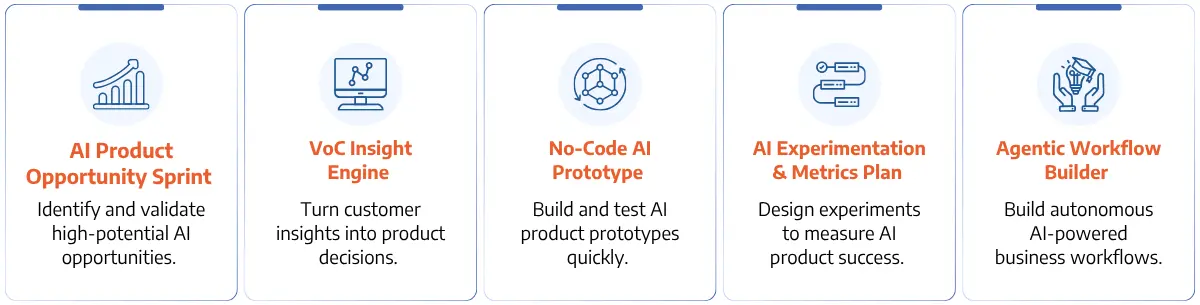
Hands-On AI Product Mini Projects
How Product Innovation with AI & Agentic AI from IIM Kozhikode Stands Out
Differentiator | What Most Product Programmes Offer | What IIM Kozhikode Enables |
Learning Outcome | Manage products and roadmaps | Build AI-powered products end-to-end |
Role of AI | AI as a feature or productivity tool | AI as the foundation of product design and execution |
Learning Approach | Frameworks, strategy, and case studies | Prototyping, workflows, projects, and real product creation |
Product Scope | Understand lifecycle concepts | Execute across discovery, design, deployment, and scale |
Thinking & Execution | Feature-level thinking | System-level thinking and AI-powered product building |
What Makes IIM Kozhikode a Preferred Destination for Learners?
#3
#4
Triple Accreditation
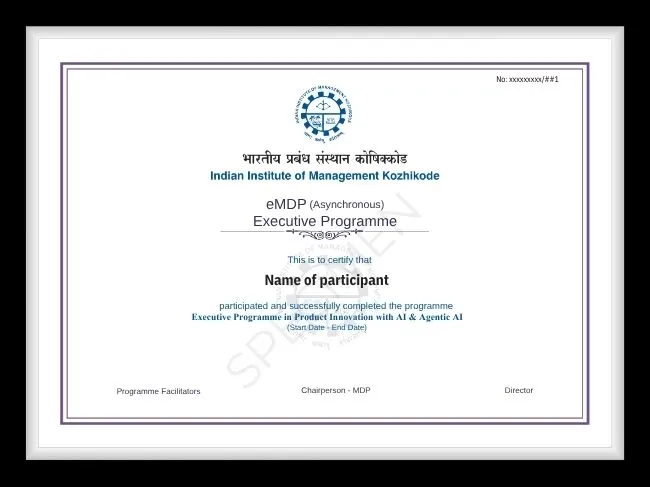
Earn a Professional Certificate in Product Innovation with AI & Agentic AI from IIM Kozhikode
Upon successful completion of the Product Innovation with AI and Agentic AI programme and achieving a minimum score of 70%, participants will receive a prestigious digital certificate from IIM Kozhikode.
This credential can be showcased on your resume, LinkedIn profile, and professional portfolio as evidence of your ability to design, build, and scale AI-powered products using Generative AI, Agentic AI, and modern product-building approaches.
Notes:
All certificate images are for illustrative purposes only and may be subject to change at the discretion of IIM Kozhikode.
A participant with less than 70% in the overall evaluation will not be awarded any certificate.
Learning Experience Designed for the Product Innovation Programme from IIM Kozhikode

Globally Renowned Faculty
Learn from the best instructors and resources from anywhere in the world.
Enhance your learning with live sessions led by expert faculty.
Access the experts, regardless of their location.

Cohort-Based Learning
Learn with an accomplished group of peers and build your network.
Gain cross-industry and cross-functional knowledge.

Flexible Learning
Learn at your own pace with high-quality, pre-recorded faculty videos.
Advance your career without disrupting your busy schedule.
Frequently Asked Questions About the Product Innovation with Agentic AI Programme
What is the Executive Programme in Product Innovation with AI & Agentic AI by IIM Kozhikode?
The Executive Programme in Product Innovation with AI & Agentic AI by IIM Kozhikode is a 20-week online programme that teaches professionals how to design, prototype, and build AI-powered products. It covers AI-first product design, Generative AI, Agentic AI, human-AI UX, product strategy, and workflow automation. The programme is delivered through pre-recorded IIMK faculty lectures, 4 live industry masterclasses, and 5 hands-on AI product projects.
How is the IIM Kozhikode Product Innovation with AI programme different from a traditional product management course?
Traditional product management courses focus on roadmaps, requirements, and feature planning. The Executive Programme in Product Innovation with AI & Agentic AI by IIM Kozhikode focuses on building — prototyping AI features, designing agentic workflows, and shipping AI-powered products end-to-end. The curriculum includes prompt engineering, no-code AI prototyping, Agile for AI, and an AI product capstone project, using 20 tools including Figma, ChatGPT, n8n, Amplitude, and Hugging Face.
Do I need coding experience to enroll in the IIM Kozhikode AI product innovation programme?
No. The Executive Programme in Product Innovation with AI & Agentic AI requires no coding or prior technical background. The programme is designed for product managers, UX designers, business professionals, and aspiring product leaders who want to build AI-first products using no-code tools, GenAI platforms, and agentic workflow builders — without writing a single line of code.
What is Agentic AI and why is it relevant for product managers in 2026?
Agentic AI refers to AI systems that can reason, plan, and autonomously execute multi-step tasks without constant human input. As of 2025, 51% of AI product teams are already building agentic products (Figma AI Report, 2025). The IIM Kozhikode Product Innovation with AI & Agentic AI programme covers agentic system design, human-in-the-loop checkpoints, autonomous workflow building, and agentic governance — core skills for product managers building the next generation of AI products.
What hands-on projects are included in the IIM Kozhikode Product Innovation with AI programme?
The programme includes 4+ hands-on AI product mini projects: an AI Product Opportunity Sprint, a Voice of Customer (VoC) Insight Engine, a No-Code Product Simulation, an AI Experimentation & Metrics Plan, an Agentic Workflow Builder, and an end-to-end AI Product Capstone. Each project maps to a stage of the AI product lifecycle — from discovery and prototyping to deployment and automation — and together form a portfolio demonstrating AI-first product design and building capabilities.
Who is the IIM Kozhikode Product Innovation with AI & Agentic AI programme designed for?
The programme is designed for product managers and product owners, UX and product designers, engineering managers and AI practitioners, founders and entrepreneurs, and professionals from consulting, marketing, or operations transitioning into product roles. It is built for anyone who needs to innovate, design, build, or lead AI-powered products — no coding experience required.
How does the IIM Kozhikode Product Innovation with AI programme cover prompt engineering for product managers?
The IIM Kozhikode Product Innovation with AI & Agentic AI programme includes a dedicated module on prompt engineering as a product design discipline. It covers prompt anatomy, few-shot design, chain-of-thought prompts, guardrails, safety prompts, and prompt governance. Applied topics include writing PRDs with AI copilots, generating UX copy and onboarding flows, automating competitor research, and evaluating prompt performance — practical GenAI skills for product managers in 2026.
What certificate will I receive after completing the IIM Kozhikode Product Innovation with AI programme?
Upon successful completion of the Product Innovation with AI and Agentic AI programme and achieving a minimum score of 70%, participants will receive a prestigious digital certificate from IIM Kozhikode. This credential can be showcased on your resume, LinkedIn profile, and professional portfolio as evidence of your ability to design, build, and scale AI-powered products using Generative AI, Agentic AI, and modern product-building approaches.
Does the Product Innovation with AI programme cover AI product strategy, metrics, and responsible AI?
Yes. The IIM Kozhikode Product Innovation with AI and Agentic AI programme includes dedicated modules on AI product strategy and competitive moats, data as a product asset, evidence-led product leadership, experimentation and A/B testing for AI features, personalisation at scale, and responsible AI governance. The governance module covers India's AI policy framework, the EU AI Act, and how to build accountability structures into AI product teams.
What are the programme details for IIMK's Product Innovation with AI and Agentic AI programme— duration, fee, start date, and eligibility?
The Executive Programme in Product Innovation with AI & Agentic AI by IIM Kozhikode is 20 weeks long, delivered fully online with live masterclasses. The programme fee is INR 1,55,000 + Applicable Taxes. The next cohort starts on 23 September 2026. Eligibility requires a Bachelor's Degree or Diploma (10+2+3). Weekly time commitment is 4–5 hours. An optional one-day on-campus networking event at IIM Kozhikode campus is available at an additional cost.
Elevate your career with this programme!
Flexible payment options available.
Starts On